
The best unusual dessert pairings share one trait: the cheese isn’t an afterthought, it’s the counterweight. Salt cuts honey, acid brightens custard, and blue veining turns a pear into something startling. Our eight picks, from baklava with whipped feta to a Canadian maple sugar pie with aged cheddar, each pair a dessert with a cheese that corrects its excess and deepens its character.
I came to this conviction one evening in Toronto, when a slice of burnt Basque cheesecake arrived beside a sliver of Manchego and a smear of membrillo. The caramelized crust, the molten centre, the quince’s floral tartness, the cheese’s nutty salinity: nothing competed, and every bite rearranged the others. That’s the standard here. Pairings that go beyond cheesecake and fruit should have a reason, a structural logic you can taste.
The list that follows is global by design, moving through Greece, the Netherlands, Thailand, France, Spain, India, Canada and Italy. Each entry explains why the combination works, suggests a glass to pour alongside it (think late-harvest Riesling, tawny Port or Icewine), and offers a quick way to reproduce the idea at home. A short selection guide opens the list, so you can judge any pairing, ours or your own, on balance of sweetness, fat, salt and texture.
How These Eight Flavor Combinations Were Chosen
Every pairing here earned its place at the table, not on a novelty list. I tasted each one, usually more than once, and kept only those where the cheese and dessert made each other better rather than simply surprising the palate.
The criteria were consistent across all eight:
- Flavor balance: sweet, salt, acid and fat have to meet in harmony, with no single element overpowering the rest.
- Texture contrast: crisp against creamy, crystalline against silken, so every bite keeps moving.
- Cultural provenance: each pairing draws on a real tradition, from Greek baklava to Quebecois sugar pie, rather than an invented gimmick.
- Local availability: the cheeses and ingredients can be found at Toronto’s cheesemongers, specialty grocers and restaurants.
- Beverage compatibility: each plate sits comfortably beside a glass of wine or spirit.
That last point matters more than it might seem. A dessert course rarely arrives without something in the glass, and a pairing that fights the pour is a pairing that fails. I considered how a late-harvest Muscat, a tawny Port or an off-dry Riesling would behave alongside each plate before it made the final list.
Availability was equally practical. A brilliant combination is of little use if the cheese lives only in a distant dairy, so every pairing here can be assembled with a modest trip across the city.
Eight Global Pairings Worth Seeking Out
1. Honeyed Baklava with Whipped Feta, Greek-Inspired Contrast
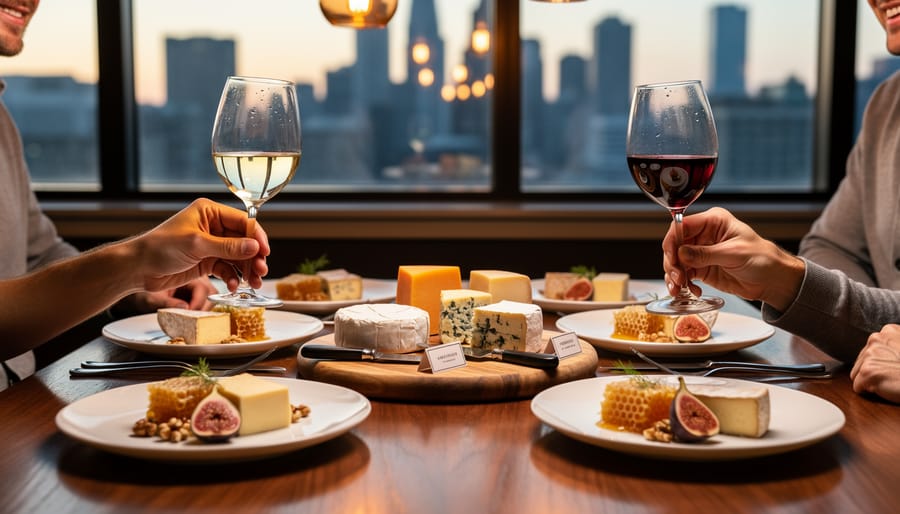
Imagine the shatter of golden phyllo giving way to a bed of crushed pistachio, then a drizzle of thyme honey pooling in the crevices. Now add a cloud of whipped sheep’s milk feta, cool and tangy, with a saline edge that cuts straight through the sweetness. That is the quiet genius of this Eastern Mediterranean pairing, where the brine of the cheese does what a pinch of salt does to caramel: it sharpens everything around it.
Baklava has long been served across Greece, Turkey and the Levant as a celebratory sweet, while feta and honey have shared plates in Greek households for generations, often as a simple breakfast or meze course. Whipping the feta with a touch of cream or olive oil softens its crumble into something silky, closer in texture to a mousse than a cheese board staple. At a small Greek table on the Danforth, I watched a server spoon it beside a warm square of baklava, and the first bite was a revelation: honey, herb, nut, salt, all in one bright chord.
For the glass, reach for a late-harvest Muscat, whose orange blossom and apricot notes echo the honey, or a Vin Santo, whose toasted-nut depth mirrors the pistachio. Either one holds its own against the feta’s salinity without overwhelming it.
2. Dark Chocolate Tart with Aged Gouda, Dutch Depth
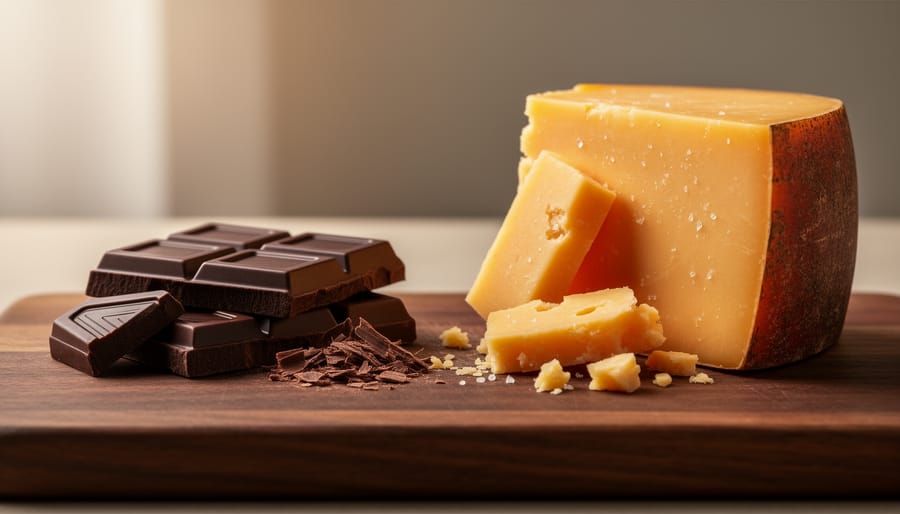
Bittersweet cocoa and long-aged Gouda share more than you’d expect. A dark chocolate tart, ideally 70 percent or higher, brings bitterness and a dense, almost truffled texture. A Gouda aged three years or more answers with butterscotch, toasted nuts and those faintly crunchy tyrosine crystals that dissolve into pure caramel. Where the chocolate is austere, the cheese is sweet and savoury at once, and the two meet in the middle.
Tannin does the quiet work here. The cocoa’s slight astringency clings to the palate, and the cheese’s fat and salt soften it, so each bite finishes rounder than the last. This is the same logic behind the Colombian tradition of cheese and hot chocolate where salty dairy tempers cocoa’s edge.
I like to serve the tart slightly cool, with thin shards of Gouda alongside rather than a heavy wedge. Pour a tawny Port, whose oxidative notes of walnut and dried fig echo the cheese, or reach for a robust Canadian icewine-style dessert red, whose concentrated dark fruit holds its own against the cocoa.
3. Mango Sticky Rice with Fresh Chèvre, Thai Brightness
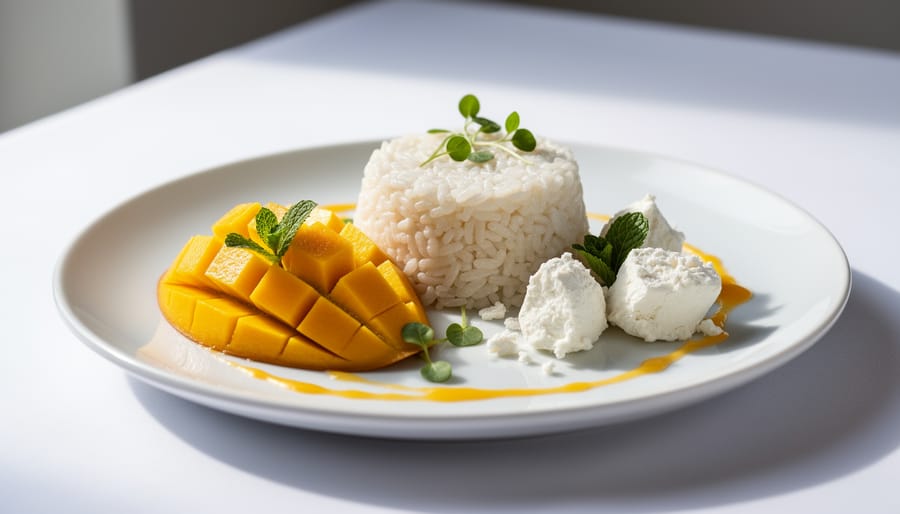
Mango sticky rice is a study in tropical restraint. Glutinous rice, steeped in coconut milk and finished with a pinch of salt, arrives warm and faintly perfumed, while slices of ripe mango bring honeyed sweetness and a bright, almost citrus-like acidity. On its own, it is a perfect Thai dessert. Add a spoonful of young chèvre, and the whole plate shifts.
The cheese’s lactic tang cuts through the coconut’s richness the way lime does in a curry, lifting the sweetness without flattening it. Its soft, clean creaminess echoes the rice, yet its gentle acidity keeps each bite lively rather than heavy. I find a light scatter of toasted sesame or a few torn mint leaves bridges the two beautifully. For anyone curious about how fresh, lightly acidic cheeses behave beside sweetness and wine, these goat cheese pairings offer a thoughtful starting point.
In the glass, choose an off-dry Riesling. Its stone-fruit sweetness mirrors the mango, while its racy acidity refreshes the palate between spoonfuls.
4. Poached Pear Tarte Tatin with Roquefort, French Sweet-and-Blue
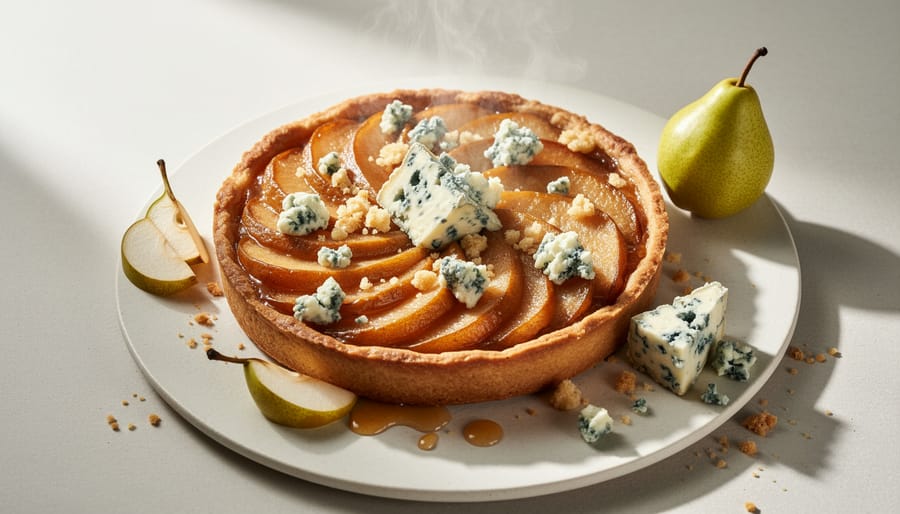
Caramelized pear tarte Tatin is the dessert that earns its place on a cheese course. The fruit turns amber and jammy, its edges kissed with butter and sugar, while the pastry shatters into flaky, golden layers. Set a small wedge of Roquefort beside it, and the plate shifts entirely. This sheep’s milk blue, aged in the limestone caves of Combalou, carries a piquant, mineral intensity and a salty, almost peppery bite that cuts through the sweetness like a bright line of acid.
The logic is the oldest in French gastronomy: sweet meets blue, and neither surrenders. The pear’s gentle perfume softens the cheese’s sharpness, while the Roquefort lends the dessert depth and a savoury edge it would otherwise lack. I tasted this at a small bistro table on Queen Street West, crumbling a little of the blue onto each forkful of warm pear, and the finish lingered long and honeyed.
For the glass, nothing rivals Sauternes. Its botrytis-kissed notes of apricot, honey and saffron mirror the caramel while its lively acidity refreshes the palate. If you want more ideas beyond this classic, our guide to dairy pairing wines offers further inspiration for the cheese course.
5. Burnt Basque Cheesecake with Membrillo and Manchego, Spanish Layering
Burnt Basque cheesecake, born in San Sebastián, is a study in deliberate scorch: a blistered, nearly mahogany top giving way to a trembling, custardy centre with a faint bitterness that keeps the richness in check. Here the cheese-based dessert meets a second cheese, and the result is a lesson in layering rather than repetition.
Alongside, set a slab of membrillo, the firm, ruby quince paste of Spanish tables, and a wedge of aged Manchego. The quince brings floral perfume and a gentle, grainy tartness, while the sheep’s milk cheese contributes a nutty, faintly piquant saltiness and a crystalline bite. A forkful of cheesecake followed by a sliver of Manchego with a dab of membrillo moves from cream to salt to fruit in a single, graceful arc.
Pour a small glass of Pedro Ximénez sherry. Its molasses, raisin and toasted fig depth echoes the caramelized crust, while its viscosity matches the cheesecake’s silkiness. Look for Manchego aged twelve months or more, which holds up to the sweetness without disappearing.
6. Gulab Jamun with Fresh Paneer and Cardamom Cream, Indian Milk-on-Milk
Gulab jamun is already a study in milk. The dumplings are made from reduced milk solids, fried until deeply bronzed, then left to drink in a syrup scented with rose water and cardamom. Serving them with fresh paneer sounds redundant until you taste it: the cheese is mild, faintly sweet and squeaky-soft, and it answers the syrup’s perfume with a clean, lactic calm.
I like the paneer lightly warmed, then folded into a cardamom cream sweetened only enough to take the edge off. Spoon a little over a hot dumpling and the contrast does the work. Syrup-slick sweetness meets cool, dairy-forward restraint, and the cardamom ties the two together with its camphor-and-citrus lift. A scatter of crushed pistachio adds a welcome snap.
This is milk-on-milk dining in the Indian tradition, where dairy is treated as a canvas rather than a mere ingredient, so the dish feels layered rather than heavy.
For the glass, a spiced chai, brewed strong with ginger and black pepper, echoes the cardamom beautifully. If you prefer something stronger, a botanical gin with rose or coriander notes, served over a single large cube, lifts the floral syrup without crowding it.
7. Maple Sugar Pie with Aged Cheddar, a Canadian Original
Sugar pie, or tarte au sucre, is Quebec’s quiet masterpiece: a humble shell filled with maple sugar, cream and little else, baked until it sets into something between custard and fudge. It is unapologetically sweet, which is precisely why a sharp, crystalline cheddar belongs beside it. Choose an Ontario or Quebec cheddar aged at least two years, one with those small crunchy tyrosine crystals that shatter against the teeth and release savory, almost brothy depth.
I first tried this pairing at a candlelit dinner in Prince Edward County, where the pie arrived still faintly warm with a thin wedge of cheddar on the side. One bite of cheddar, then a forkful of pie, and the salt amplified the maple’s toasted, almost smoky edges while the pie’s richness softened the cheese’s bite. The interplay of caramel, sharp tang and buttery crumb was quietly revelatory.
For the glass, a barrel-aged maple spirit adds vanilla and oak that echo the pie’s caramelized notes. If you prefer wine, an Ontario Vidal icewine offers honeyed apricot and bright acidity that lifts the whole plate. Look to local cheesemakers at Toronto’s St. Lawrence Market, where producers from both provinces are well represented.
8. Smoked Almond Torta di Mandorle with Ricotta Salata and Fig, Italian Rusticity
Torta di mandorle is the quiet workhorse of the Italian pastry case: dense, buttery and deeply nutty, with a crumb that holds up to bolder partners. Toast the almonds until they smell almost smoky, and the cake takes on a roasted depth that leans toward the savoury side of dessert. Add figs roasted until their edges caramelize and their centres turn jammy, and you have sweetness with real backbone.
Ricotta salata is where the pairing turns. Pressed, salted and aged, it is firm and crumbly rather than creamy, with a clean, milky saltiness that sharpens everything around it. Shave it thinly over a warm slice and watch it soften slightly against the fig. The salt lifts the almond’s sweetness, while the smoke in the nuts echoes the fig’s browned sugars.
Pour a small glass of Vin Santo, whose oxidative notes of dried apricot, hazelnut and caramel mirror the cake’s toasted character. For something brighter, a Passito di Pantelleria brings orange peel, honeyed apricot and a saline lift from its island vineyards. Either wine lets the cheese’s salt finish the story.
Quick Reference: Matching Cheese Styles to Dessert Flavors
Think of the eight pairings as four simple rules you can carry to any cheese counter or dessert menu. Salty cheeses, such as feta and ricotta salata, flatter honey, figs and other concentrated fruit. Bitter or deeply roasted desserts, like the dark chocolate tart, need the caramel and nuttiness of an aged cheese such as Gouda or cheddar to soften their edge. Fresh, lactic cheeses suit bright, floral or tropical sweets, which is why chèvre and paneer sit so comfortably beside mango and cardamom. Blue cheese, finally, rewards anything caramelized or poached, where its mineral piquancy has some sweetness to push against.
The same instinct that guides a good glass of Port or Sauternes, where sweetness answers salt, applies at the table, and if you enjoy the classic logic of wine and cheese you already own most of the framework.
Building Your Own Pairing Board: Questions Readers Ask Most
Building a board that holds together comes down to a few practical decisions, and most of them are simpler than they look. Think of the plate the way a sommelier thinks of a flight: each element should make the next one taste better. If you would like to see this logic demonstrated hands-on, a guided pairing class is an excellent way to train your palate before hosting.
For sourcing, Toronto’s independent cheesemongers and specialty grocers are your best allies. Ask for a taste, describe the dessert you are serving, and let them steer you toward a wedge at its peak. Two or three pairings is plenty for a dinner party; more than that and the palate tires. Start with the lightest, such as the chèvre with mango sticky rice, and finish with the boldest, perhaps the Roquefort alongside the tarte Tatin.
What temperature should cheese be served at with dessert?
Take it out of the refrigerator 30 to 60 minutes beforehand. Cold mutes flavour and keeps the texture stiff, while a cheese at cool room temperature shows its full aroma and creaminess.
Should I pair the wine to the cheese or to the sweet element?
Match the wine to the sweeter component first, as the drink should be at least as sweet as the dessert. Then check that it still flatters the cheese; a late-harvest Muscat or a tawny Port tends to bridge both.
How do I keep a plate from becoming cloying?
Keep portions of dessert modest and let the cheese carry the salt, acid and fat. A few unsweetened nuts or a sharp fruit slice resets the palate between bites.
What is a good starter pairing for guests new to cheese?
Aged cheddar with maple sugar pie is approachable and familiar. Fresh chèvre with ripe mango is another gentle entry, mild and bright rather than pungent.
When in doubt about beverages, off-dry Riesling, Vin Santo and tawny Port are the most versatile across both courses, flexible enough to follow you from creamy to crystalline without missing a step.
The Final Pour: Choosing Your First Pairing
Every pairing here rests on the same principle: let the cheese’s salt, tang or funk meet something sweet, floral, smoky or bitter, and each side tastes more like itself. Begin where you feel most at ease, perhaps the maple sugar pie with a sharp, crystalline cheddar, and notice how the sweetness softens the bite while the cheese deepens the caramel. Once that logic clicks, venture outward to the Roquefort and pear tarte Tatin or the Manchego beside burnt Basque cheesecake.
Toronto makes the exploration easy. Visit a good cheesemonger, ask what is ripe and singing that week, and keep an eye out for these combinations on the city’s dessert menus. Pour something worthy of the plate, and let the next course be your own discovery.