
Toronto’s culinary renaissance owes much of its momentum to a cadre of dedicated educators who train the chefs shaping the city’s dining landscape. These instructors, working across renowned institutions like George Brown College’s Chef School and private academies, blend classical French technique with contemporary innovation, mentoring students who go on to helm some of the country’s most celebrated kitchens. Their influence extends beyond curriculum: through industry partnerships, apprenticeship networks, and a rigorous focus on seasonality and sustainability, they’re instilling a philosophy that elevates Toronto’s restaurant scene to international prominence.
I’ve witnessed this impact firsthand. Sitting across from Chef Alain Bosse, former executive chef at Auberge du Pommier and now senior professor at George Brown, he explained how his program emphasizes terroir and local sourcing, not as trend but as foundation. “We teach students to understand their ingredients before they touch a knife,” he told me over coffee at his test kitchen. “A tomato from Holland Marsh tastes nothing like one from California. That awareness becomes the basis for everything they create.”
The educators profiled here represent a cross-section of Toronto’s teaching talent: Michelin-trained chefs who returned to Canada to mentor, pastry masters who’ve redefined dessert standards, and sommeliers who integrate beverage knowledge into kitchen training. Their collective expertise has produced graduates now earning accolades at Alo, Enigma, and DaNico, among others. Understanding who these mentors are, and how they approach the craft, offers insight into why Toronto’s dining culture continues to mature with such sophistication and depth.
The Evolution of Culinary Education in Toronto
Thirty years ago, culinary training in Toronto meant standing beside a seasoned chef in a hotel kitchen, learning through repetition and correction. Apprentices spent months perfecting mirepoix before touching a protein, absorbing technique through observation rather than structured curriculum. The path was straightforward: master classical French foundations, work your way up the brigade system, perhaps travel to Europe if you were fortunate.
That model has fundamentally evolved. Today’s culinary programs in Toronto reflect the city’s position as a global dining destination, where a single street might offer Cantonese dim sum, Persian kebabs, and modernist tasting menus within three blocks. Educators now design curricula that acknowledge this reality, teaching students to navigate multiple culinary traditions with equal fluency. George Brown College’s Chef School, for instance, integrates regional cooking techniques from across Asia, the Middle East, and Latin America alongside classical European methods, recognizing that tomorrow’s chef must command a broader repertoire.
The integration of wine and beverage studies represents another significant shift. Twenty years ago, sommelier training existed separately from culinary programs, if it existed formally at all. Now, respected programs require aspiring chefs to understand wine regions, pairing principles, and beverage service as core competencies. When I spoke with instructors at several Toronto institutions, they emphasized that students must comprehend how a wine list elevates a menu, how to cost beverages properly, and why a sommelier is a chef’s creative partner rather than a separate department.
Molecular gastronomy and modern techniques have moved from novelty to standard curriculum. Students learn sous vide precision, spherification, and emulsification science not as gimmicks but as additional tools. One instructor explained it plainly: understanding why an emulsion breaks teaches you how to prevent it, whether you’re making mayonnaise or a beurre blanc.
Perhaps most crucially, business acumen now receives serious attention. Toronto’s culinary educators watched too many talented cooks open restaurants only to fail on costing, labor management, or marketing. Contemporary programs address P&L statements, social media strategy, supplier negotiations, and staff management alongside knife skills. The goal is producing chef-entrepreneurs who can sustain careers, not just cook beautifully for three years before burning out.
Leading Culinary Institutions and Their Visionary Educators
The Wine and Sommelier Mentors
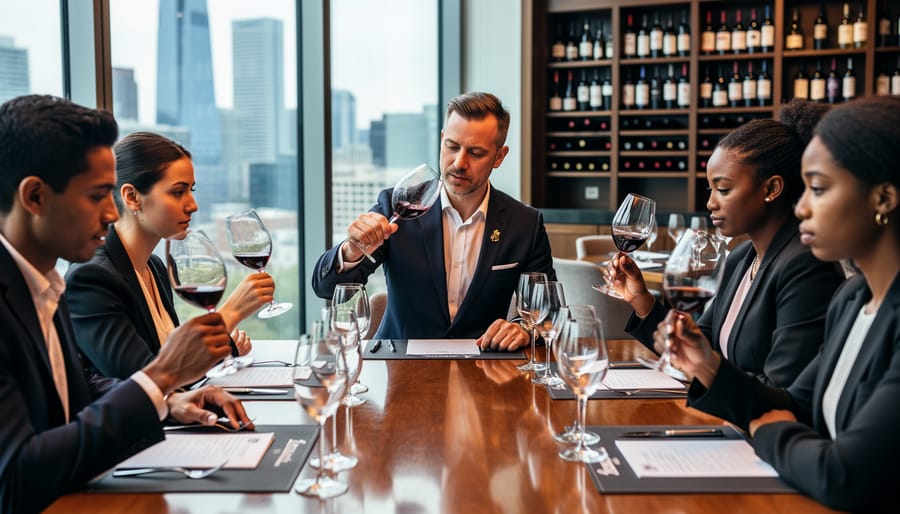
During a recent visit to George Brown College’s hospitality campus, I sat with Master Sommelier Catherine Fallis, whose teaching philosophy centers on demystifying wine while maintaining reverence for the craft. “Toronto diners expect their sommeliers to be storytellers, not lecturers,” she explained, pouring a Niagara Riesling for demonstration. “I teach my students to read the table first, the wine list second.”
This approach defines Toronto’s wine education landscape. At Humber College, Advanced Sommelier James Grant structures his program around practical service scenarios, students practice tableside decanting during simulated dinner services, learning to gauge guest comfort levels while discussing Burgundy terroir. His graduates staff the wine programs at Alo, Canoe, and other establishments where $300 bottles demand both expertise and emotional intelligence.
The Wine & Spirit Education Trust programs, offered through several Toronto institutions, produce certified sommeliers who understand the business alongside the beverage. Instructor Maria DaSilva emphasizes wine-and-food harmony rooted in Toronto’s multicultural dining scene: “My students pair Barolo with Korean short ribs and Chablis with sushi because that’s what our city demands.”
These mentors share a common goal, preparing sommeliers who can navigate rare Burgundy allocations, build restaurant wine programs, and, crucially, make guests feel confident rather than intimidated. The result is a generation of beverage professionals elevating Toronto’s wine culture to international standards.
The Fine Dining Technicians
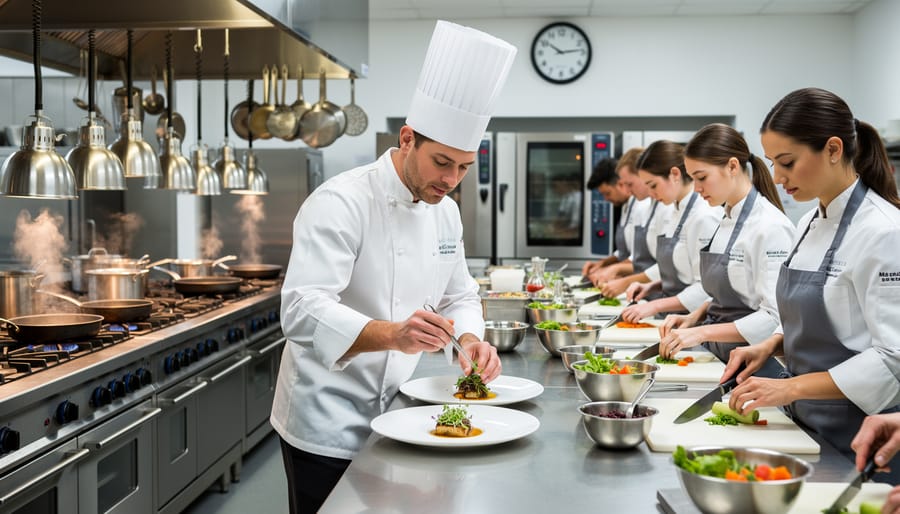
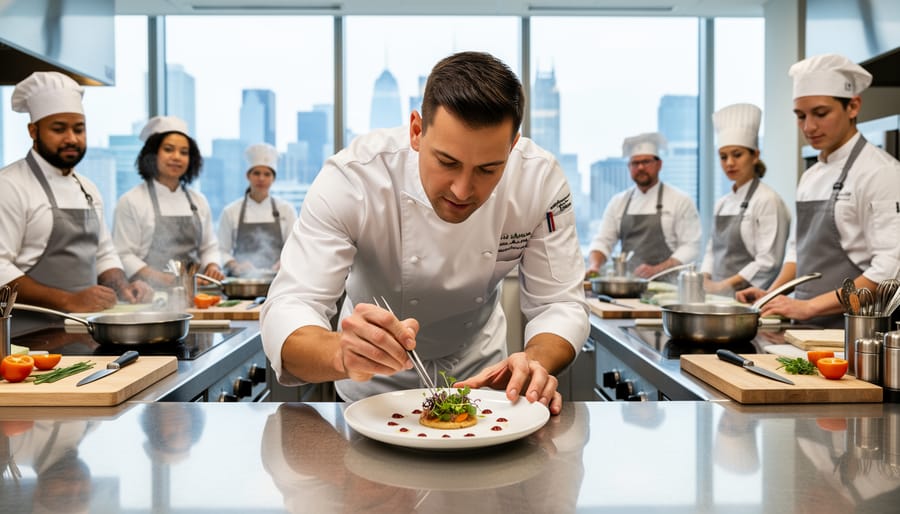
I met Chef Laurent Beaumont in the pristine teaching kitchen at George Brown College’s Centre for Hospitality and Culinary Arts, where every stainless surface reflected the afternoon light. After earning his stripes at two Michelin-starred restaurants in Lyon, he now spends his days translating that exacting culture to Toronto students. “I don’t teach recipes,” he told me, adjusting a student’s knife angle with surgeon-like precision. “I teach the philosophy of why a dish exists.”
This approach defines Toronto’s fine dining educators. Chef Sarah Chen, formerly of Alo, demonstrates how the principles governing a $300 tasting menu apply to everyday cooking: mise en place as meditation, the geometry of a perfectly centered protein, sauce work that respects both tradition and terroir. During a recent visit to her advanced plating class, I watched students recreate identical compositions twenty times, each iteration refining symmetry and negative space.
What distinguishes these educators isn’t nostalgia for brigade systems but their ability to distill technique into teachable frameworks. Chef Marcus Thompson, who staged at The French Laundry, emphasizes that precision serves creativity. “You master brunoise before you deconstruct anything,” he explained, guiding a student through classical knife cuts. His students understand that breaking culinary rules requires first knowing them intimately, a philosophy now visible across Toronto’s ambitious dining rooms.
Teaching Philosophy: From Classical Techniques to Innovation
Toronto’s culinary educators occupy a delicate territory, one foot planted firmly in centuries of French tradition, the other stepping into a future shaped by sustainability mandates, indigenous ingredients, and molecular innovation. In conversations with instructors across the city’s leading programs, I’ve observed how they navigate this balance with remarkable intentionality, refusing to sacrifice technical mastery for novelty’s sake while equally rejecting the notion that classical methods alone suffice for today’s kitchens.
The foundation remains non-negotiable. Students still spend months perfecting their mother sauces, learning knife skills that would satisfy Escoffier, and understanding why a proper mise en place isn’t merely organization but philosophy. Chef Gabrielle Rousseau, who teaches at one of Toronto’s premier culinary institutes, explained it to me over espresso at her favourite Ossington café: “You cannot innovate what you don’t understand. The garde manger techniques, the precision of a perfect consommé, these are the grammar of our language. Once fluent, then you compose poetry.”
But the poetry matters, and that’s where contemporary Toronto educators distinguish themselves. They integrate foraging workshops with local Indigenous knowledge keepers, teaching students about wild leeks and sumac berries before those ingredients appear on tasting menus. They dedicate entire modules to waste reduction and nose-to-tail cooking, framing sustainability not as trend but as culinary imperative. Fermentation labs sit beside classical pastry kitchens. Students learn sous vide temperatures with the same rigor they apply to traditional roasting.
Wine and spirits education has evolved from afterthought to cornerstone. The city’s most progressive programs now require sommelier-level training as part of their core curriculum, recognizing that Toronto’s discerning diners expect kitchen staff who can discuss terroir as confidently as technique. Students taste through Burgundy classifications while practicing brunoise cuts, understanding that a perfectly seared scallop deserves an equally considered pairing.
Several key principles define this pedagogical approach:
- Master classical foundations before deconstructing them
- Integrate wine knowledge with culinary technique from day one
- Prioritize local, seasonal ingredients alongside imported luxury products
- Teach sustainability as fundamental skill, not optional enhancement
- Balance precision and creativity through structured experimentation
- Connect historical context to contemporary innovation
The result is graduates who can execute a textbook coq au vin while also conceptualizing entirely new flavour combinations rooted in Ontario’s agricultural landscape. They understand wine service protocols and can recommend unconventional pairings that challenge convention intelligently. This dual competency, reverence for tradition married to fearless innovation, has become Toronto’s culinary education hallmark, producing chefs who elevate the city’s dining scene precisely because they refuse to choose between the old guard and the avant-garde.
Beyond the Classroom: Mentorship in Toronto’s Restaurant Scene
The real education begins when the classroom doors close and the kitchen heat rises. During a service at Alo, I watched chef-instructor Patrick Kriss guide a George Brown extern through the delicate assembly of a seafood course, his corrections surgical and immediate. “Feel the temperature of the protein,” he instructed, fingers hovering just above the surface. “Now tell me if it needs another fifteen seconds.” This isn’t pedagogy from a textbook; it’s the transfer of instinct honed over decades, the kind that transforms competent cooks into exceptional chefs.
Toronto’s most influential culinary educators understand that technique learned in a controlled classroom must be tested in the chaos of professional service. The externship programs embedded in nearly every serious culinary program send students into kitchens where the stakes are real and the learning curve vertiginous. At Canoe, I spoke with sous chef Marcus Chen about mentoring a rotating cast of culinary students. “They arrive knowing how to brunoise and make stock,” he explained, “but they haven’t learned how to think three stations ahead during a Friday rush, or how to recover when a course goes sideways.” That situational intelligence, he emphasized, can only be acquired through immersion.
The apprenticeship model, experiencing a renaissance in Toronto’s fine dining establishments, creates deeper bonds between master and protégé. Chef Tobey Nemeth of Osteria Giulia described his mentorship approach during a conversation in his kitchen. “I’m not just teaching recipes or plating. I’m passing along a philosophy about ingredients, seasonality, and the respect owed to both the product and the guest.” His current apprentice, a recent George Brown graduate, shadows him through every service, observing how decisions made at 6 a.m. at the St. Lawrence Market ripple through that evening’s menu.
These relationships reshape careers in ways formal education cannot. The sommelier who trained under sommelier Jai Tugnait at Buca now manages one of the city’s most ambitious wine programs. The pastry chef mentored by Roselle Desserts’ Bruce Lee opened her own patisserie in Leslieville. They carry forward not just technical skills but entire philosophies about hospitality, quality, and the relentless pursuit of excellence that defines Toronto’s upper echelon dining scene.
The Impact on Toronto’s Dining Culture
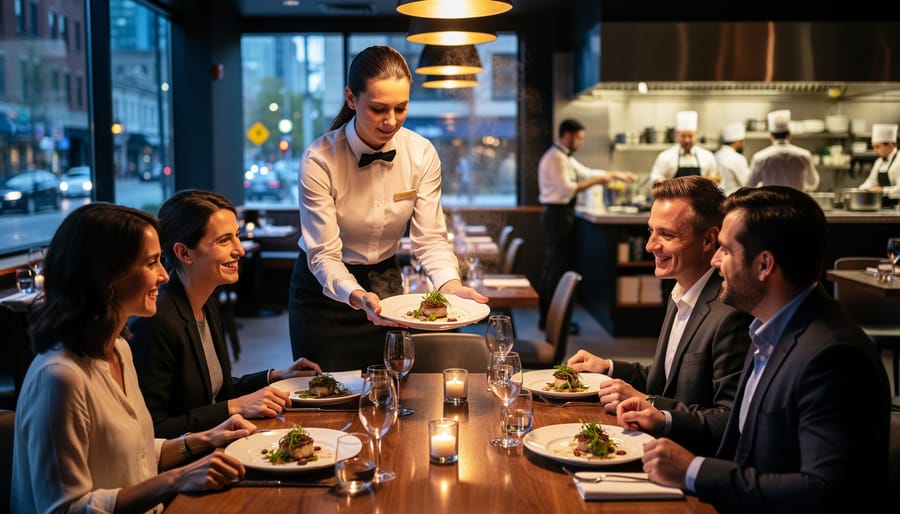
The fingerprints of Toronto’s culinary educators appear across the city’s finest dining rooms, from King West tasting menus to Yorkville wine bars. Walk into any acclaimed restaurant and you’ll likely find alumni from George Brown, Stratford Chef School, or mentorship under local luminaries shaping the experience. These graduates don’t simply replicate what they learned; they interpret, refine, and push boundaries while maintaining the technical rigor their instructors demanded.
| Restaurant | Educator/Program | Specialty | Year Established |
|---|---|---|---|
| Alo | George Brown College | French technique, wine pairing | 2015 |
| Edulis | Stratford Chef School | Seasonal Mediterranean | 2008 |
| Enigma Yorkville | Centennial College hospitality | Tasting menus, sommelier-driven | 2018 |
| Osteria Giulia | George Brown pasta program | Italian precision, handmade pasta | 2019 |
The influence extends beyond individual restaurants. Toronto’s reputation for impeccable service standards stems directly from hospitality programs emphasizing guest relations and wine service. When sommeliers present bottles with genuine knowledge rather than scripted descriptions, when line cooks execute 200 covers without compromising technique, that consistency reflects institutional training. The city’s wine programs, in particular, have matured remarkably. A decade ago, finding a server who could discuss Niagara terroir with authority was rare; now it’s expected at establishments above a certain tier, thanks to integrated beverage education.
Innovation flourishes where fundamentals are solid. Chefs trained in classical French methods now deconstruct those techniques through modernist lenses, confident their foundation allows experimentation. The emphasis educators place on local sourcing has permeated menus citywide, transforming farmer relationships and seasonal consciousness. Toronto’s ascent as a dining destination isn’t accidental. It’s the cumulative result of thousands of hours spent in teaching kitchens, tasting rooms, and mentorship conversations, manifesting nightly across hundreds of establishments where precision, creativity, and hospitality converge.
Common Questions About Culinary Education in Toronto
Which culinary programs in Toronto offer serious wine and sommelier training?
George Brown College’s Culinary Management program includes dedicated wine studies and sommelier certification tracks, while Humber College integrates beverage management throughout its curriculum. Private institutes like the Canadian Sommelier School offer intensive certification programs specifically for aspiring sommeliers and hospitality professionals.
What’s the typical investment for culinary education in Toronto?
Two-year diploma programs at established institutions range from $15,000 to $30,000 in tuition, though private culinary academies and specialized wine certification courses can run higher. Many students offset costs through restaurant apprenticeships, which provide both income and hands-on experience during their studies.
How important is formal education versus apprenticeship in Toronto’s fine dining scene?
Toronto’s premium restaurants increasingly seek candidates who combine formal training with practical experience. While classical apprenticeships remain valuable, most executive chefs and sommeliers I’ve interviewed emphasize that structured programs provide essential foundation in technique, food science, and wine knowledge that accelerates career progression in sophisticated establishments.
Can graduates realistically work at Toronto’s top restaurants after completing these programs?
Graduates from Toronto’s leading culinary programs regularly secure positions at the city’s Michelin-recognized and destination restaurants, though typically starting in commis or junior sommelier roles. The connections formed through educator networks and externship placements prove as valuable as the credentials themselves in this relationship-driven industry.
The decision to pursue culinary education represents more than career training, it’s entry into a community of mentors, peers, and industry professionals who shape Toronto’s dining culture. When choosing a program, consider not just curriculum but the educators’ active involvement in the restaurant scene, their professional networks, and their teaching philosophy. The best programs offer access to working chefs and sommeliers who bring current industry practices into the classroom, ensuring what you learn today applies to the kitchens and wine cellars you’ll work in tomorrow.
The artistry gracing Toronto’s finest tables doesn’t emerge from nowhere. Behind every perfectly executed demi-glace, every thoughtfully curated wine list, every plate that balances technical precision with creative audacity stands an educator who passed the torch. These mentors serve as custodians of centuries-old techniques while simultaneously pushing their students to question, experiment, and ultimately surpass them.
What makes Toronto’s culinary education landscape exceptional isn’t merely the transmission of skills. It’s the cultivation of philosophy, the understanding that hospitality is service elevated to art, that wine knowledge deepens the dining narrative, that sustainability and excellence need not conflict. The educators profiled here have created a virtuous cycle: their alumni open restaurants that become training grounds for the next wave, their teaching philosophies ripple through kitchens across the city, their commitment to both tradition and innovation keeps Toronto’s dining scene dynamic rather than static.
Walking through the dining rooms and wine bars where their graduates now lead, you’ll taste the evidence of this mentorship. That sommelier confidently guiding you through an ambitious by-the-glass program learned from someone who believed education extends far beyond certification. That chef coaxing unexpected flavors from local ingredients absorbed lessons about respecting product and pushing boundaries simultaneously.
The most meaningful way to celebrate these educators? Reserve a table at the establishments their students have built. You’re not just enjoying a meal, you’re experiencing the continuation of a legacy.